
Museums are collecting more audience data than at any point in history. Every ticket purchase, membership renewal, donation, and email click creates a valuable layer of insight. In theory, this data should drive better decision-making and stronger visitor relationships. In reality, 77% of institutions are dealing with rising operating expenses while their staff remain buried in spreadsheets, CSV exports, and manual data reconciliation.
The problem isn't a lack of technology. Most museums have plenty of software. The challenge is that these digital tools were adopted piecemeal over time, creating a fragmented digital infrastructure where nothing actually connects.
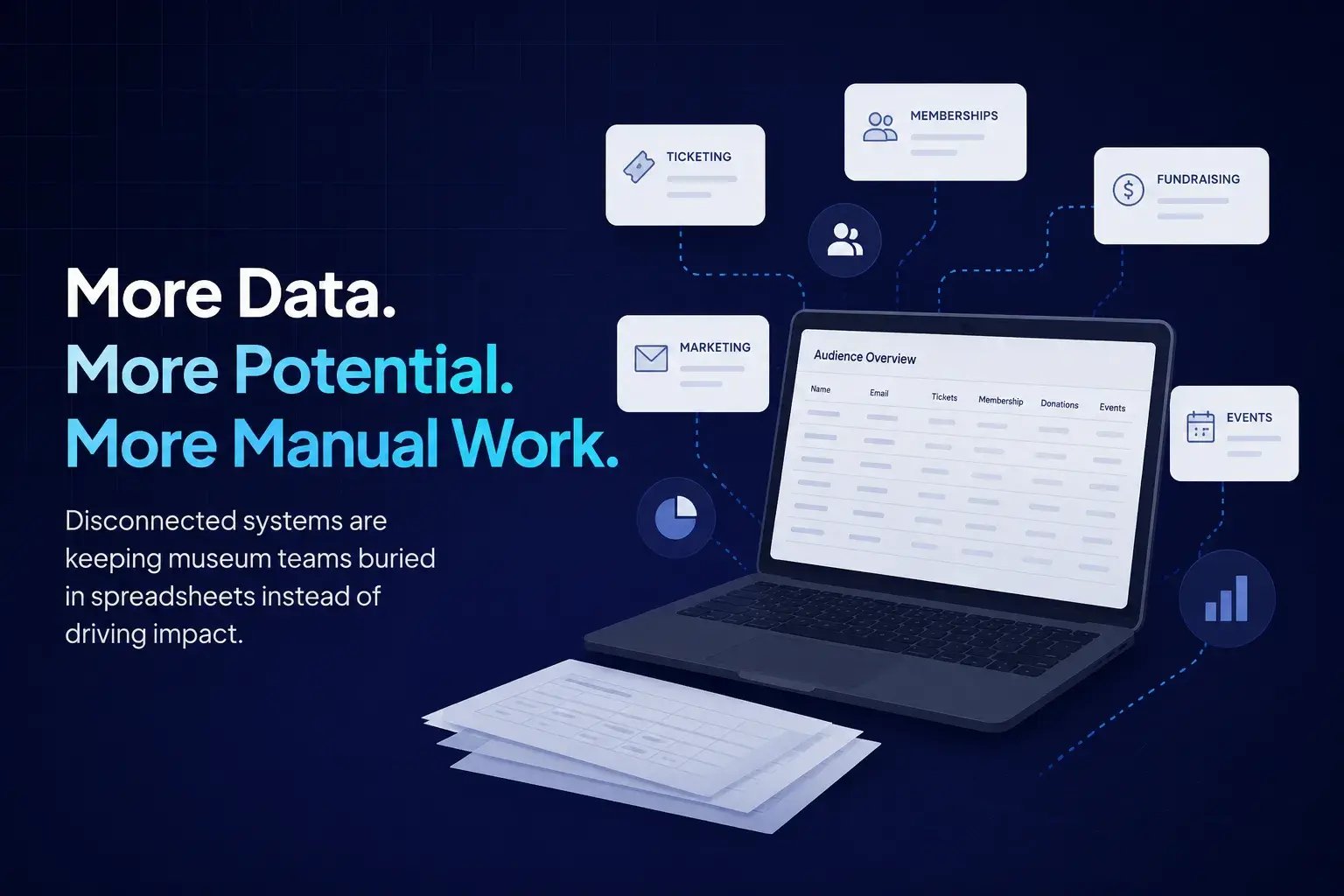
Why Museum Teams Are Still Buried in Spreadsheets
Ask a simple audience question inside a museum, and the answer often turns into a multi-system search.
Which visitors came to the last three paid programs? Which members also donated this year? Which donors recently attended an event? Which households are engaging across more than one department?
The answers may exist, but they are rarely sitting in one clean, easy-to-use view.
A visitor may purchase tickets through one system, maintain a membership in another, donate through a separate fundraising platform, and engage with marketing emails sent through yet another tool entirely. Individually, each platform serves a purpose. Together, they create operational silos that make it difficult to see the full constituent relationship clearly.
Marketing teams may not know which members recently attended an event. Development teams may lack visibility into visitor engagement before donor outreach. Visitor services staff may operate from entirely separate records than fundraising or membership teams. Over time, even simple questions become harder to answer.
The information technically exists. It just isn’t centralized in a way that makes it useful across the institution. That fragmentation creates blind spots that slowly affect day-to-day operations, reporting accuracy, audience engagement, and staff efficiency.
The Real Cost of Fragmented Systems Is Staff Time
Take a museum preparing for a donor cultivation event.
The development team wants to invite high-potential supporters who have shown recent engagement. On paper, that sounds simple. In practice, the information is scattered.
Ticketing has attendance history. The membership platform has renewal status. The fundraising system has donation records. The email platform has campaign engagement. Event staff may have their own spreadsheet from past programs or receptions.
Before anyone can confidently build the invite list, someone has to export data from each system, clean duplicate records, compare names and email addresses, check which memberships are current, confirm recent giving activity, and manually piece together who should actually be included. That process takes hours. Sometimes days.
And even after all that work, the team may still be operating from partial information. A donor may look inactive in the fundraising system but recently attended three paid programs. A member may appear highly engaged in email reports but have an expired membership. A visitor may have attended multiple events, but their activity may never make it into the CRM in time for outreach.
This is how fragmented systems quietly turn staff into human data bridges. The operational drag shows up in ways many museum teams know all too well:
- duplicate constituent records across departments
- manual event reconciliation workflows
- delayed donor or membership reporting
- inconsistent audience segmentation
- conflicting data between teams
- time-consuming spreadsheet cleanup before campaigns or reports
- limited visibility into cross-department engagement
None of these problems usually feel urgent on their own. Together, they consume significant staff capacity and make routine work feel heavier than it should.
Why This Gets Harder as Museums Grow
The operational challenges created by disconnected systems tend to intensify as museums expand their programs, audiences, and digital engagement efforts.
More events create more attendance data. More campaigns create more audience interactions. More memberships, donations, exhibitions, and educational programs generate more operational complexity across departments. At the same time, many museum teams are being asked to accomplish more without significantly increasing internal capacity.
What may have once been manageable with a few spreadsheets and manual exports becomes increasingly difficult to sustain at scale. A process that takes 20 minutes per week at a smaller institution may eventually consume hours across multiple departments. Reporting requests become slower. Cross-team coordination becomes more difficult. Staff confidence in the data begins to erode because different systems often produce conflicting information.
Audience expectations are evolving too. According to Accesso’s 2026 visitor sentiment analysis, queuing conversation share doubled from 1.46% in 2023 to 2.90% in 2025, while booking experience complaints are also rising. Visitors are paying attention to the full experience, from the first digital touchpoint to the on-site visit, and disconnected systems make that harder to manage well.
Visitors increasingly expect museums to recognize them consistently across interactions. They do not think in terms of separate ticketing systems, fundraising databases, membership platforms, and marketing tools. They experience the museum as a single institution.
AI and Automation Are Raising the Stakes
At the National Archives Museum, AI is being used to help visitors explore The American Story, a new exhibit built around more than two million historic records. Visitors can select topics that interest them, then receive historical content tailored to those interests and revisit their personalized selections online later.
The important part is what has to happen behind the scenes. NARA’s public AI inventory says the project uses Azure OpenAI to automatically generate tags and topics for approximately two million digital records, with the goal of improving document discoverability and personalizing the visitor experience.
That is the real lesson for museums looking at AI and automation. The visitor-facing experience may feel seamless, but it depends on information being organized, searchable, structured, and ready for the system to use.
The same principle applies to museum operations. When audience data is scattered across different systems, newer tools can only work with fragments of the full constituent picture. A donor record may exist in one platform, recent event attendance may live somewhere else, and membership status may be updated in a separate system entirely. That makes it harder for automation, reporting, and personalization tools to act on the most complete and current information.
This is where disconnected operations become more visible. Automated workflows may route people based on outdated membership data. Dashboards may produce conflicting results because departments are pulling from different records. Audience segments may miss important engagement signals because event, ticketing, donor, and marketing activity are not connected.
Newer technologies often reveal these gaps faster. As museum operations become more sophisticated, shared visibility becomes more important across departments. Museums are entering a period where operational maturity depends less on how much data an institution collects and more on how easily teams can access, trust, and use that data together.
How MuseumHub Brings Museum Data Into One Connected System
After years of working around disconnected tools, many museum teams do not need another platform added to the pile. They need a clearer way to bring the work they already manage into one place.
This is the operational challenge MuseumHub was built to address.
Built inside HubSpot, MuseumHub extends the platform with museum-specific functionality designed around how institutions actually operate. That includes memberships, ticketing workflows, donor engagement, household relationships, events, audience communication, and cross-department visibility within the same environment.
When those activities live in the same system, teams can start working from a shared view of each constituent. Development can see more than donation history. Membership teams can understand engagement beyond renewal status. Marketing can build segments based on fuller audience behavior. Leadership can rely on reporting that reflects activity across departments, not just one slice of the institution.
This kind of connected setup reduces the need for staff to manually stitch information together before they can act on it. Reports become easier to trust. Audience segments become more useful. Internal coordination becomes less dependent on whoever happens to know which spreadsheet or export has the latest information.
For museums already using HubSpot, MuseumHub adds the museum-specific structure needed to manage these relationships more effectively. And for teams still trying to understand where their current stack is slowing them down, our Museum Tech Assessment offers a practical starting point before making any bigger systems decisions.
➡️Take the Museum Tech Assessment to see where disconnected data is creating extra work for your team.