
Securing a multi-year commitment from a major donor or corporate partner is one of the strongest signals of trust a nonprofit can earn. But closing the pledge is only the beginning. The real challenge (and opportunity) comes in sustaining accuracy and stewardship over several fiscal years, across multiple departments, and through inevitable staff transitions.
For enterprise nonprofits, managing a multi-year pledge means keeping governance, visibility, and accountability front and center, well beyond simply recording payments. Finance, development, and leadership all need the same clear picture of what’s promised, what’s received, and what’s on the horizon.
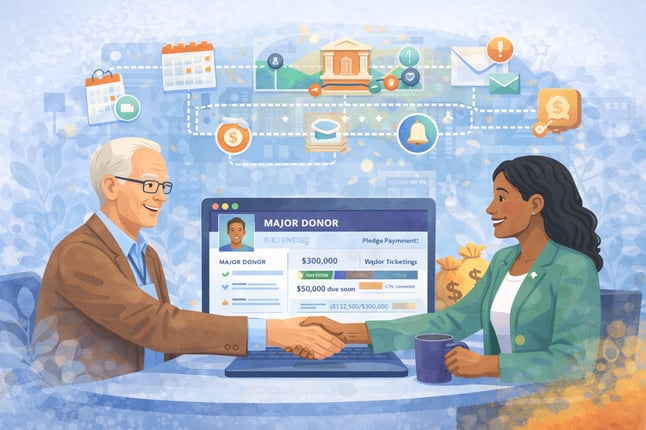
Why Multi-Year Pledges Matter
On paper, a multi-year pledge looks simple: a donor commits, you track installments, the money arrives. But the reality is far more tangled. Every installment ripples across finance, development, programs, and the boardroom. Missed communication or unclear reporting can mean compliance risk, frustrated funders, or leadership blindsided by numbers that don’t match.
Here’s what that looks like:
Cross-department dependencies. A pledge touches every corner of the organization. Finance needs a clean pledged vs. received view for audits and compliance. Development needs to know exactly what’s committed to forecast campaigns and report to donors. Program teams depend on accurate timelines so they don’t plan services with money that hasn’t arrived yet. Without a central system, teams work off different spreadsheets and reports, creating silos, duplicated effort, and avoidable mistakes.
Complex pledge structures. Not every pledge is a straight line. Some increase year over year (step-up gifts), some depend on conditions being met, others include corporate matches across subsidiaries, or hybrid commitments with both cash and in-kind support. Each variation carries different accounting rules and stewardship needs. Treating them all the same, or trying to track them in generic fields, creates reporting errors and donor confusion.
Stewardship at scale. Major donors and institutional funders expect more than an annual thank-you letter. They want installment-based updates tied to impact: what their $1M installment funded this quarter, how it advanced the initiative, and what’s next. When dozens of large pledges are in play, manually managing this level of touchpoint quickly overwhelms staff.
Executive expectations. Leadership doesn’t want “we’ll get back to you.” Boards and C-suites expect real-time answers: How much of this $5M pledge is booked this fiscal year? How much risk are we carrying into next year? Which commitments are restricted, and which are flexible? If finance and development aren’t aligned, those answers vary depending on who’s asked, a credibility problem no nonprofit can afford.
Staff and system turnover. Large pledges stretch over years, but staff don’t always stay that long. Without a system that captures full context, terms, recognition, conditions, a pledge can lose continuity when a gift officer or finance lead departs. Legacy CRMs often bury these details or make them hard to surface at the exact moment leadership needs them.
How to Manage Multi-Year Pledges Effectively
Managing multi-year pledges well is what separates organizations that keep their major donors from those that lose momentum after Year 1. At scale, it only works if the process is codified in your CRM, otherwise details get lost, teams work from different numbers, and donor confidence eventually erodes.
Here’s how your nonprofit can build a pledge management framework in HubSpot that’s sustainable, auditable, and donor-centered.
1. Formalize the Commitment
Clear, documented agreements establish expectations around payment schedules, recognition, conditions, and contingencies, giving both the organization and the donor confidence in how the commitment will be managed over time.
👉🏽How HubSpot helps: HubSpot centralizes pledge documentation by attaching digital agreements or PDFs directly to the donor record and storing key terms as structured properties such as start date, installment cadence, and recognition level. This ensures development, finance, and leadership are all working from the same source of truth, without relying on email threads or institutional memory.
2. Centralize Tracking in Your CRM
When pledges live in spreadsheets or disconnected systems, important context gets lost. Finance may track expected revenue, development tracks relationships, and programs plan based on partial information. Without a shared system, teams end up working from different assumptions about the same commitment.
👉🏽 How HubSpot helps: HubSpot allows pledges to be tracked as Deals within a dedicated “Major Gifts & Pledges” pipeline, with structured fields capturing details such as pledge type, restrictions, installment terms, step-up clauses, or matching requirements. By associating each pledge with the relevant contacts and organizations, every team works from the same record, seeing both the financial timeline and the conditions attached to the commitment in one place.
3. Automate for Accuracy and Stewardship
As pledge portfolios grow, manual reminders become unreliable. Payment schedules stretch across fiscal years, staff roles shift, and even well-managed teams can lose track of key moments. When follow-ups depend on memory or ad hoc tracking, the risk is not just delayed payments, but erosion of donor confidence and unnecessary pressure on finance teams.
👉🏽 How HubSpot helps: HubSpot brings structure and consistency to multi-year pledge management by tracking payment milestones in one shared system and triggering the right actions automatically. Installment due dates can generate internal alerts for finance teams, while donors receive timely acknowledgments, impact updates, or reports tied to each payment. For longer commitments, workflows can also surface renewal conversations well before a pledge ends, giving development teams the space to steward relationships proactively instead of reacting at the last minute.
4. Align Finance and Development Reporting
As organizations scale, misalignment between development forecasts and finance reporting becomes a common source of friction. When teams rely on separate systems or spreadsheets, numbers drift, leadership loses confidence in projections, and conversations shift from strategy to reconciliation. That gap slows decision-making and complicates planning at every level.
👉🏽How HubSpot helps: HubSpot supports shared reporting by bringing pledge and payment data into unified dashboards that update in real time. Teams can view pledged versus received revenue, monitor overdue installments through aging views, and track campaign or initiative progress directly against pledge revenue. With one system powering reports for gift officers, finance leaders, and the board, everyone works from the same data and decisions are grounded in a single, consistent source of truth.
5. Use HubSpot AI to Scale Stewardship Without Losing Personalization
Large pledge portfolios raise expectations. Donors giving over multiple years expect communication that reflects where they are in the commitment, what their gift has enabled, and what comes next. Delivering that level of specificity manually becomes difficult as volume increases, even for well-staffed teams.
👉🏽 How HubSpot helps: HubSpot’s AI capabilities support stewardship at scale by drafting installment-aware donor updates, enriching donor profiles with relevant external signals such as corporate or philanthropic activity, and analyzing engagement patterns to surface renewal opportunities at the right time. When paired with structured pledge data, AI helps teams maintain relevance and timeliness without defaulting to generic messaging.
How HubSpot Helps Nonprofit Teams Manage It All
Tracking a single pledge in a spreadsheet is manageable. Managing a portfolio of multi-million-dollar commitments, each with step-ups, restrictions, or matching terms, is not. As volume and complexity increase, manual tracking breaks down and visibility disappears across teams.
This is where HubSpot gives large nonprofits an advantage.
Pipeline tracking.
Pledges are modeled as deals in a dedicated “Major Gifts & Pledges” pipeline. Stages align to installments or fiscal years, giving finance, development, and leadership a shared view of what has been fulfilled and what remains outstanding.
Automated reminders.
Workflows alert finance ahead of due dates, prompt development to deliver stewardship touchpoints, and surface renewal conversations before the final installment is received.
Custom dashboards.
Real-time reporting shows pledged versus received revenue without reconciliation. Finance, development, and the board all work from the same numbers in the same system.
By centralizing pledge data, automating follow-up, and aligning reporting, HubSpot reduces operational drag. Teams spend less time chasing numbers and more time stewarding the relationships that lead to renewals and long-term stability.
|
Download the PDF here and see how pledge tracking works in HubSpot step by step. |