
Most nonprofits adopt new technology with good intentions and to solve problems as they arise. Much like plugging a leak. The fundraising team needs better donation tracking. Marketing wants clearer campaign reporting. Programs need a system that works for their workflows. Each decision is reasonable in the moment and often necessary to keep work moving.
Over time, those decisions begin to interact. Information lives in different places, processes diverge by team, and leadership struggles to see the full picture without manual reconciliation. Work becomes harder, not because teams lack effort or expertise, but because systems were never designed to support shared outcomes.
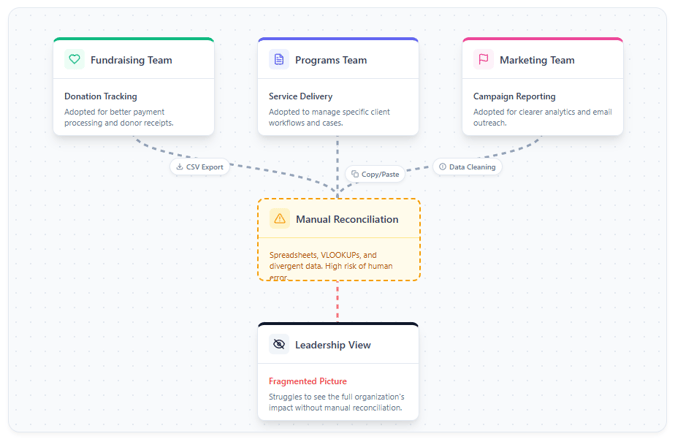
This is how point solutions quietly sabotage impact. They optimize individual functions while creating long-term friction that slows decision-making, complicates reporting, and pulls attention away from mission-critical work. A connected CRM strategy helps reverse this pattern by aligning data, workflows, and teams around a shared system of record.
Once organizations recognize the limits of point solutions, the next question becomes practical: what does a more connected CRM approach actually look like?
There is no single platform that fits every nonprofit. Different CRMs reflect different assumptions about data structure, fundraising models, team workflows, and long-term growth. Understanding those differences is more useful than chasing feature checklists.
Below are several established and emerging nonprofit CRMs that organizations often evaluate when moving toward a more centralized, intentional system.
Top 5 Established & Emerging Nonprofit CRMs for 2024
1. HubSpot for Nonprofits
HubSpot is often associated with marketing automation, but many mission-driven organizations use it as a broader system for managing constituent relationships, engagement, and reporting. Its value comes from combining CRM, communications, and analytics in one platform that teams across the organization can use. Rather than focusing on individual tools, HubSpot supports a connected approach where donor data, engagement history, and outreach live in the same system. This structure is especially useful for organizations that need visibility across fundraising, marketing, and operations.
Strengths
Organizations often choose HubSpot for its ability to support growth without adding operational complexity. Common use cases include:
- Centralizing donor management: Track interactions, segment supporters, and tailor communications using shared constituent data.
- Supporting fundraising workflows: Automate recurring giving, manage event-related engagement, and integrate donation data into the CRM.
- Coordinating marketing and outreach: Build email campaigns, manage social channels, and automate follow-up using consistent data across teams.
- Reporting and insight: Use customizable dashboards and reports to understand donor behavior, campaign performance, and engagement trends.
Together, these capabilities support a more connected approach to fundraising and engagement, while allowing teams to focus on strategy and relationship-building rather than system maintenance.
Best fit for 👉🏽 HubSpot is often a strong fit for nonprofits that want to centralize donor engagement, marketing, and automation while maintaining flexibility as programs and teams evolve. It is commonly used by organizations that value cross-team visibility and want a platform that can adapt over time without extensive reconfiguration.
2. Blackbaud
Blackbaud’s Raiser’s Edge NXT is a long-standing CRM built specifically for nonprofit fundraising and donor management. It is commonly used by organizations with established development operations that rely on detailed donor records, grant tracking, and structured fundraising programs. Raiser’s Edge NXT is designed to support traditional fundraising workflows and complex reporting requirements, particularly for organizations that manage large donor databases and long-term giving programs.
Strengths
Blackbaud offers deep donor management capabilities, advanced reporting, and fundraising tools built specifically for nonprofit use cases. Its data model supports detailed gift history, campaign tracking, and grant management, which can be valuable for organizations with mature fundraising operations and formal reporting needs.
Considerations
The platform’s functionality comes with added complexity. Teams may face a steeper learning curve, and customization often requires technical expertise or external support. Pricing and implementation costs can also be significant, which makes careful evaluation important to ensure long-term sustainability.
For organizations that can support its administrative demands, Raiser’s Edge NXT provides a fundraising-focused system with deep nonprofit-specific functionality.
Best fit for 👉🏽 Raiser’s Edge NXT is often a fit for larger nonprofits that require detailed donor profiles, complex fundraising structures, and grant tracking at scale. Organizations with dedicated database or development operations staff tend to benefit most from its depth.
3. Neon One
Neon One’s Neon CRM is designed to support nonprofit organizations with straightforward fundraising and donor management needs. It combines core CRM functionality with peer-to-peer fundraising and event tools, all within a platform built specifically for nonprofits. Neon One emphasizes usability and accessibility, making it easier for teams to manage everyday fundraising and engagement without extensive configuration or technical overhead.
Strengths
Neon CRM offers an intuitive interface and a focused set of tools for donor management, event coordination, and basic fundraising automation. Its nonprofit-first design helps teams get up and running quickly while covering essential engagement workflows. For organizations that value simplicity and clarity, Neon CRM supports day-to-day operations without introducing unnecessary complexity.
Considerations
As organizations grow, Neon CRM may present limitations around advanced reporting, complex data models, and scalability. Nonprofits with expanding programs, multiple departments, or sophisticated analytics needs may eventually outgrow the platform. For organizations with more straightforward requirements, Neon CRM provides a focused solution that supports fundraising and engagement without heavy administrative demands.
Best fit for 👉🏽Neon CRM is often a good fit for small to mid-sized nonprofits that want an affordable system to manage donors, events, and fundraising activity in one place. It works well for teams that prioritize ease of use and need core functionality rather than advanced customization.
4. Salesforce Nonprofit Success Pack (NPSP)
Salesforce’s Nonprofit Success Pack (NPSP) is built on Salesforce’s enterprise platform and is designed to support organizations with complex data, reporting, and integration requirements. It provides a flexible framework that allows nonprofits to design CRM workflows around their specific operating models. NPSP functions less as a ready-made nonprofit system and more as a configurable foundation. Organizations shape donor management, fundraising processes, and reporting structures through customization and configuration.
Strengths
Salesforce NPSP offers extensive flexibility and a broad ecosystem of integrations. Nonprofits can customize objects, workflows, and data models to support highly specific requirements, making it possible to align the CRM closely with organizational processes and long-term strategy. The platform’s scalability supports growth across programs, teams, and data volume when properly managed.
Considerations
The same flexibility that makes NPSP powerful also increases complexity. Configuration, maintenance, and user adoption often require ongoing technical expertise. Without sufficient support, organizations may struggle to realize the platform’s full value. For nonprofits with the capacity to manage a highly configurable system, Salesforce NPSP provides a scalable foundation that can evolve alongside organizational needs.
Best fit for👉🏽 Salesforce NPSP is often a fit for large or complex nonprofits with well-defined workflows and access to technical resources. Organizations with in-house administrators, development teams, or implementation partners tend to benefit most from its flexibility.
5. Bloomerang
Bloomerang focuses on donor retention and relationship management, with tools designed to help nonprofits understand engagement patterns and maintain long-term supporter relationships. Its interface and reporting emphasize clarity, making it easier for teams to track donor activity without extensive setup. Bloomerang is often used by organizations that want straightforward insight into donor behavior and retention trends rather than highly customized workflows.
Strengths
Bloomerang offers retention-focused metrics and accessible reporting tools that help teams monitor donor engagement and giving patterns. Dashboards are designed to be easy to interpret, which supports regular use by fundraising staff and leadership alike. For organizations focused on improving retention, Bloomerang provides clear visibility into supporter relationships without requiring heavy configuration.
Considerations
Bloomerang’s focus on retention can limit flexibility for organizations that require advanced fundraising workflows, marketing automation, or cross-department data coordination. Nonprofits with expanding programs or more complex engagement strategies may eventually need a platform with broader capabilities.For organizations centered on donor stewards hip and clarity, Bloomerang offers a focused solution that supports long-term relationship building.
Best fit for👉🏽 Bloomerang is commonly a fit for small to mid-sized nonprofits that prioritize donor retention and want a CRM that simplifies tracking and reporting. It works well for teams that need actionable insight into engagement without managing complex automation or data models.
6. Keela
Keela is an all-in-one CRM designed for nonprofits that want built-in guidance around donor engagement and fundraising. The platform incorporates data-driven insights to help teams identify patterns in donor behavior and prioritize outreach. Keela’s approach centers on simplifying decision-making for fundraising teams by highlighting engagement signals and trends rather than requiring extensive manual analysis.
Strengths
Keela provides insight-driven tools that help nonprofits understand donor engagement and tailor outreach accordingly. By surfacing patterns in giving and interaction history, the platform supports more informed fundraising and stewardship efforts without requiring complex configuration. Its interface is designed to be approachable, which can help teams adopt data-informed practices more quickly.
Considerations
Keela’s functionality may be more limited for organizations that require advanced reporting, extensive integrations, or highly customized data models. Nonprofits with complex operations or cross-departmental needs may eventually need a platform with broader flexibility. For organizations focused on improving donor outreach through clearer insight and simpler tools, Keela offers a focused, accessible option.
Best fit for👉🏽 Keela is often a good fit for nonprofits looking for an affordable, data-informed CRM that supports donor engagement and fundraising without the overhead of more complex enterprise platforms. It works well for organizations that want built-in guidance rather than highly customized workflows.
HubSpot Empowers All Nonprofits
HubSpot is sometimes assumed to be a better fit for smaller organizations, but that assumption overlooks how the platform is designed to scale. Its flexibility and extensibility allow nonprofits to configure the system around their structure, workflows, and reporting needs, whether they are supporting a single program or managing operations across multiple teams and regions.
Rather than prescribing a fixed nonprofit model, HubSpot provides a foundation that organizations shape over time. This makes it possible to support both day-to-day engagement and long-term growth without replatforming as needs evolve.
Key HubSpot Capabilities
- Robustness and extensibility HubSpot offers a broad set of tools and integrations that allow nonprofits to configure the platform around their specific requirements. As programs expand or reporting needs change, the system can be adapted without introducing additional fragmentation.
- Flexible by design Because HubSpot is used across industries, it continues to evolve with improvements to automation, reporting, and data management. Nonprofits benefit from these advancements while retaining control over how the platform is applied to donor engagement and operations.
- Scalability across teams and programs HubSpot supports organizations at different stages of growth by allowing functionality to expand alongside capacity. Teams can start with core CRM and engagement tools and add complexity only when it is needed.
Through our work with a wide range of nonprofit clients, we have seen HubSpot support both enterprise-level organizations with complex operations and smaller teams looking to bring structure and clarity to their engagement efforts.
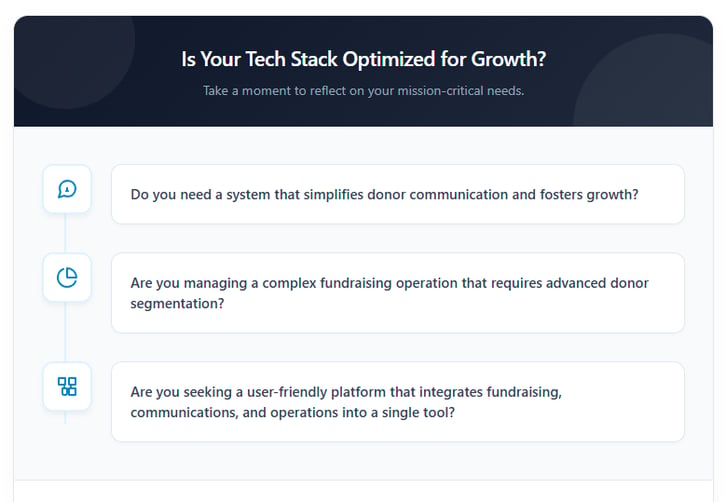
Understanding these factors will help you choose a CRM that grows with your organization, enabling you to maximize your mission's impact. To get started, book a free consultation to see how we can support your mission.
